

Driving Schools: Your Path to License Success
13 September 2023Master the Road: 5 Essential Tips for New Drivers in Stellenbosch
24 November 2026
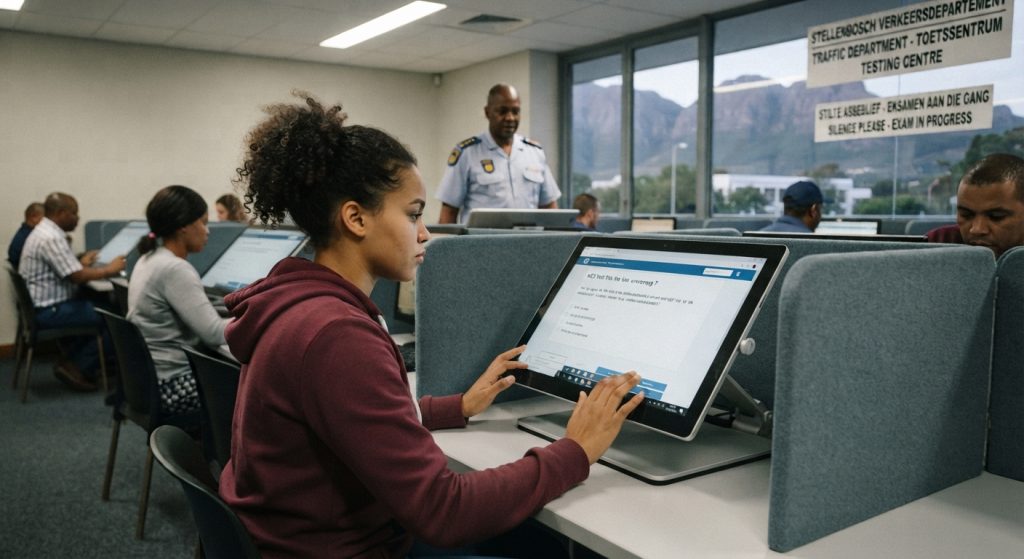
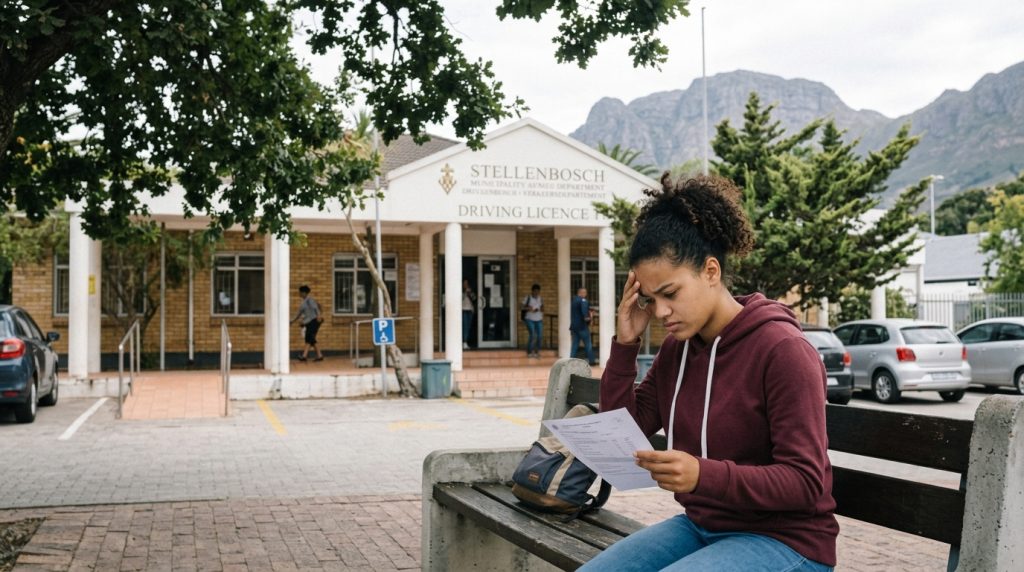
You’ve studied the K53 book. You’ve done the practice papers on your phone. You showed up on time, passed the eye test, paid your fee, and you still walked out with a “fail.”
You’re not alone. In fact, you’re in the majority.
Since the government rolled out its new Computerised Learner’s Licence Testing (CLLT) system the digital, touchscreen, tablet-based replacement for the old paper booklet test the national pass rate for the learner’s licence has collapsed from around 68% to just 40%. That means more than half of everyone who sits the test now fails it.
And in the Western Cape, home to Stellenbosch, Cape Town, George, Mossel Bay and the entire Garden Route — the picture is even starker. According to figures released by the provincial government, only about 17% of applicants have been passing the new digital test. That’s right: roughly one in six. In some individual testing centres the number is even lower.
So if you’re sitting in your car in Cloetesville wondering whether you’re the problem… you’re not. The system is.
And there’s a reason why, and a way through it.
What changed when the test went digital
For years, the K53 learner’s test was a pen-and-paper booklet. You knew what to expect. You could buy a practice paper, and more importantly, you could actually see the style of the questions coming at you.
Then the RTMC (the Road Traffic Management Corporation) replaced it with the CLLT. Here’s how the new system works:
- You sit at a touchscreen terminal at the driving licence testing centre.
- Your identity is verified with a fingerprint scan — so no more “jockeys” sitting the test in someone else’s place.
- The system generates your questions at random from a national database of roughly 1,200 questions. No two candidates get the same paper. No paper can be leaked in advance.
- Your answers are marked the instant you finish. No examiner to argue with. No second chances.
The government’s spin on this is positive, and honestly, on paper, it makes sense. The old system was full of corruption: leaked question papers, examiners tipping off candidates, bribes running from R3,000 to R6,000 just to skip the test, and “jockeys” driving qualified candidates through on someone else’s behalf. The digital system closes all those doors.
The RTMC is actually celebrating the 40% pass rate. In their framing, the drop isn’t a sign the test got harder — it’s a sign that the people who used to cheat their way through have been exposed. The 40% are the ones who genuinely know the rules of the road.
That’s a fair point. But it misses what’s actually happening on the ground.
What people are actually complaining about
Read the forums, the Facebook groups, the local news comments, and the parent emails, and a very clear pattern of frustration emerges.
“I got full marks on every practice test — and still failed.”
This is the single most common complaint, and it’s devastating. A father in Mossel Bay told local news his son was getting full marks on the official K53 South Africa app — and yet “failed solidly” on the real test. “This new system does not test your knowledge of the rules of the road,” he said. “It tests your ability to read tricky questions.”
The problem? The practice papers and apps people are studying from don’t match the questions on the real test. The K53 handbook — the go-to manual for years doesn’t even contain all the information needed for the computerised test. One expert in driver training, after seeing the complaints, wrote the test himself during a preview session. Out of 20 people, only three passed — and all three worked in the driving industry.
“I failed by one point. Twice.”
A parent writing to a local paper described her child failing the test twice — both times by exactly one point. “At first we assumed it was the app,” she wrote. “After the first attempt we switched to the official K53 book. The result was the same: failed by one point.” What really stung wasn’t the failure itself, it was the lack of transparency. Candidates aren’t allowed to see their test afterwards or even find out which questions they got wrong. So they go home and have no idea what to fix.
“The whole room failed.”
A father in the Garden Route told his story after writing his own test to “prove it’s not that hard.” He’d studied for a month, worked through the K53 and eNaTIS books, even used AI to generate his own practice exams. He finished his section comfortably — and still failed. In a room of over 20 candidates, not a single person passed. When he asked the facilitator how that was possible, he was told: “Most of the time it’s between 1% and 10% that pass. At least I had a 50% pass rate once.”
“The questions are confusing and completely different from what I studied.”
In George, a mother told local news her daughter had written the test seven times and failed by one point each time. On her fourth attempt, the system showed her she’d passed all three sections. She stood in line for an hour to book her licence appointment — only to be told she hadn’t passed. “They’re not even allowed to know what they answered incorrectly,” she said. “So she’s going to answer the same questions incorrectly every time.”
“I passed on the old system. I failed on the new one.”
A resident told local news she’d passed her learner’s licence on the first attempt under the old system. When it expired and she rebooked on the new digital test, she failed. “The questions were centred around the weight limitations of vehicles I would never even be in,” she said. “Completely different from the general road knowledge I was asked about the first time.”
The common thread in every single complaint? People are studying the wrong thing, and when they fail, they have no idea why.
Why the new test is so much harder to beat?
Here’s what most people don’t understand about the K53 test, old or new: it’s not marked as one test. It’s marked as three separate tests, and you have to pass all three.
The 64-question test is split into three sections, each with its own pass mark:
| Section | Questions | Pass Mark |
| —- | —- | —- |
| Rules of the road | 28 | 22 (you can get 6 wrong) |
| Road traffic signs | 28 | 23 (you can get 5 wrong) |
| Controls of the vehicle | 8 | 6 (you can get only 2 wrong) |
Fail even one section, and you fail the whole test.
There’s no overall percentage. There’s no “well, I scored 90% overall so it should be fine.” If you ace rules and signs but get two vehicle-control questions wrong, you’re home with a fail — even with 95% of the total.
This is the mechanic behind almost every “failed by one point” story. People study signs for two weeks, skim controls the night before, and walk in feeling confident. Then they drop the one section that has the least margin for error — and the whole thing collapses.
And with the new randomised system, you can no longer guess which sections will carry weight. The draw is wider, the questions are trickier in their wording (“(i) and (iii) only”), and you get 60 minutes for 64 questions — less than a minute a question if you want to read each one properly.
The people who are passing now? They’re the ones who practise the format, not just the content. They know how the three sections work together. They’ve done timed simulations. They’ve seen the randomised question style before test day.
And here’s the part nobody tells you: you don’t know which section is weak until you’ve tested yourself against the actual format — not a random app or an old practice paper.
The system we built for exactly this

At Niklaas & Nita’s Driving School in Stellenbosch, we watched this play out in real time. When the CLLT system landed at the Stellenbosch Traffic Department on 28 March 2025, we saw what it did to our students — and to the whole local driving school industry. Appointment backlogs stretched to a month or more. Students who’d been passing the old test suddenly kept failing the new one. And the standard “buy a K53 book and memorise it” advice simply stopped working.
So we did the only thing that made sense. We built our own digital K53 simulation system.
Not an app. Not a link to a generic website. We went into the government’s actual K53 Simulation Test — the same randomised, digital format that the RTMC uses — and we replicated it, question by question, for our students.
Here’s what that means for you:
- You’re practising on the exact format you’ll face.
Our system randomises questions the same way the government system does. When you sit at the terminal on test day, the layout, the flow, the style of the questions will feel familiar. Not foreign. Not “where have I seen this before?” Familiar. - You can practise 24/7, anywhere, on your phone or PC.
No more waiting for a class at a specific time. No more driving to a facility. You log in from your bedroom, from work, from a queue — whenever suits you. You take the test as many times as you need. There’s no cost in “wasting a copy.” - You get your results — and we analyse them with you.
This is the part that matters most. When you submit your answers, you get your results. And crucially, one of our instructors gets a copy of your results too. We look at where you’re losing marks, is it rules? Signs? Controls? and we work with you to fix the specific weakness before you book your real test.
No more failing by one point and having no idea why.
No more walking out of the testing centre and wondering what went wrong.
No more sitting through the same confused, unprepared cycle.
You walk into the digital test already knowing the format, already knowing your weak sections, and already fixed them.
Why this isn’t just another practice app
You’ve probably used one of those free K53 apps. Maybe two. And you’ve probably failed anyway.
Here’s why they don’t work:
- They don’t match the government’s randomised system. The question style, the distractors, the way the options are worded, they’re off. You’re building familiarity with the wrong test.
- They don’t give you section-level feedback. You get a score. Maybe a percentage. But you don’t know which of the three sections is the one that’s going to fail you.
- Nobody is on the other end. You take the test, you get a number, you’re on your own. There’s no human looking at your results and saying, “You’re strong on rules, you’re weak on controls, here’s what to fix.”
Our system was built specifically to close that gap. It’s not a general K53 quiz. It’s a replica of the actual government digital test, wrapped around a human instructor who reviews your results and guides your preparation — before you ever step into a testing centre.
We’re the only driving school in Stellenbosch with this system in place. Not because it’s hard to build, but because most schools didn’t think to do it. They kept selling the old approach. We didn’t.
What to do now
If you’re planning to write your K53 learner’s test or you’ve already failed it and you’re done guessing, here’s the path:
- Get access to our digital K53 simulation system. Log in, take the test, see where you stand.
- Let us analyse your results with you. We’ll show you your weak sections. We’ll show you exactly what to fix.
- Practise until the format is boring. Not until you “feel ready.” Until the randomised questions feel like home.
- Book your real test when you’re ready — not when the appointment system allows.
The 40% who are passing the new digital test aren’t smarter than the 60% who aren’t. They just prepared for the right test.
You don’t have to figure this out alone. And you don’t have to keep failing by one point.
Ready to be in the 40%?
Book your first digital K53 simulation today and stop guessing on test day.

